viernes, 7 de noviembre de 2014

ETHICS WHEN DOING BUSINESSES AND THE NEW PERCEPTION OF BEAUTY

For this class there are many important topics, the Relativism versus the universalism, the first one refers to the judgment of the morality based on the legal and social standards of each society and the second refers to the judgment of the morality of action on one universal guiding principle, in this one we can find many global  or as it says universal principles like, respect and support internationally recognized human rights in your area or influence, or fight corruption in all of its forms including extortion and bribery, or stimulate all practices that eliminate any form of discrimination in the workplace. For another part the recommendations to conduct business legally, In order to be successful in the country you are doing businesses, in first instance is important to learn and have in mind the laws of the host country, in order to avoid misunderstandings or troubles with the government; the business practices applied normally in the country can also help as a basis or guide for yours. For this is important to establish communication with people that already have their business done, or the embassy, or the chambers of commerce. You have to perform due diligence investigation on the person that will work as agent, representative, distributor and so on. It is important to communicate in a clear way the policies to every sales employee, it’s important to have clear and ensure that they understood what was said, so it is important to restate often. You have to state and communicate the policies to the business contact, in order to avoid uncomfortable or undesirable moments. As a bible to your company is important to have in mind the three principles, which are to respect core human values, respect the local traditions, and context matter when deciding what is wrong or right.

My research question is based on the question made about the globalization and its repercussion in the perception of beauty, because I think is very interesting to develop.

The rapidly evolving planet and the “modern society” are changing our perception of beauty due to the creation of new necessities to become “perfect”, leading that way men and women to cosmetic surgery as a “new standard of beauty”. It can be consider that nowadays symmetry and hyper feminine features are seen as more attractiveness, so there is a need for comparison with the new standards of models or famous, with surgery in their chest, bottom, stomach, nose, neck, legs or Botox in their lips, chicks, and so on; and which is not helpful is that by living in a connected world, people are bombarded daily with images that incentive our desires to become that “perfect”. In my opinion our perception of beauty has become fake, being more important the plastic or cosmetic beauty than the natural one. The makeup, fake lashes, color eye contacts, and getting tan have become part of our beauty perception, specially the makeup, without It, we feel ugly, simple, and in some way less or inferior.

http://www.dradamson.com/toronto_reconstructive_facial_surgery.html

This video will explain in a better way what i want to express about our new perception of beauty:



jueves, 6 de noviembre de 2014

THE ONION MODEL AND THE HERMENEUTICS

The most important topic for this class is the Hofstede’s onion model. The onion model is based on some layers starting with the symbols, the heroes, the rituals and finally in the middle the values, so let’s explain each one; the symbols are referring to words, gestures and meanings that carry a complex meaning, an example can be the pope as the maximum exponent of the catholic church, all the things he says or does, have a big repercussion in the culture behavior, other example can be the Colombian flag, which each color, and the “escudo” represents our story and what we possess, "Yellow, for the sun and land of the people and for sovereign and justice. Blue, for the water that holds up the people and finally, Red, for the blood shed by the people who fought for the independence of Colombia."  (http://en.wikipedia.org/wiki/Flag_of_Colombia)
When talking about heroes we refer to persons that have a highly prized characteristic and that have made a mark or distinction in the history, for example the Dalai Lama. The rituals refer to collective activities which are essential for the society, like the Olympic Games or the beauty pageant, or the mass every Sunday. And the values, important and significant part of a person, they refer to the beliefs and attitudes that are non-negotiable, because they define us.
As the research question I will like to go deeper into the hermeneutics, because I think it interesting to understand and quite complex. The proponents were Heidegger, and Gadamer. It is consider as the science of interpretation, it covers in first instance the art and in second stance the theory of interpretation and the understanding of linguistic and non-linguistic expressions. It has emerged as a crucial branch of biblical studies, and later on the study of ancient and classic cultures, then, it turned philosophical, as the condition of the possibility for a symbolic communication, and more over the understanding of the human life and existence. The hermeneutics circle is considered as “the interpretation and understanding that no observation or description is free from the effects of the observer's experiences, pre-suppositions, and projections of his or her personal values and expectations”, in simple words, the circle of interpretation.


METAPHORS AND CRITICISM

The most important topic in this class was the Metaphors, because it is an easier way to understand or to explain how a culture behaves by supplementing dimensional approaches, and that way improving the interaction with them. With the Use of a metaphors we can give direct clue about essential features that describes the culture, for example we had the case of the Spain bullfight, as a way to describe the Spain culture, their traditions and likes, it shows how the collectivism is directed to small groups like the family, friends, town or region, showing in that way the shared need for defense, so team work is considered as something natural. It also explains the importance of trusting the other with the “moment of truth” given to the matador when he is preparing for the kill; the dominant values in the culture are caring for others and the quality of life. The bullfights show the emotional and passionate nature they have; they like to live in the moment without a great concern about the future. Is important to highlight that there are other ways to describe or try to understand a culture, this is my what we know as criticism, one way is the most common one which is stereotyping, known as the action of adopting a thought about a specific type of individual, for example, all the Japanese people are shy (even do not of them may behave that way). The other way is just creating a thought or image by what others have experience and described to us, for example a person told me not to give gifts to Germans because they will get angry, so I created that image in my head without knowing it was truth or not, or people that goes to the India and then says they are very dirty, so you create or adopt that image or thought in your head.

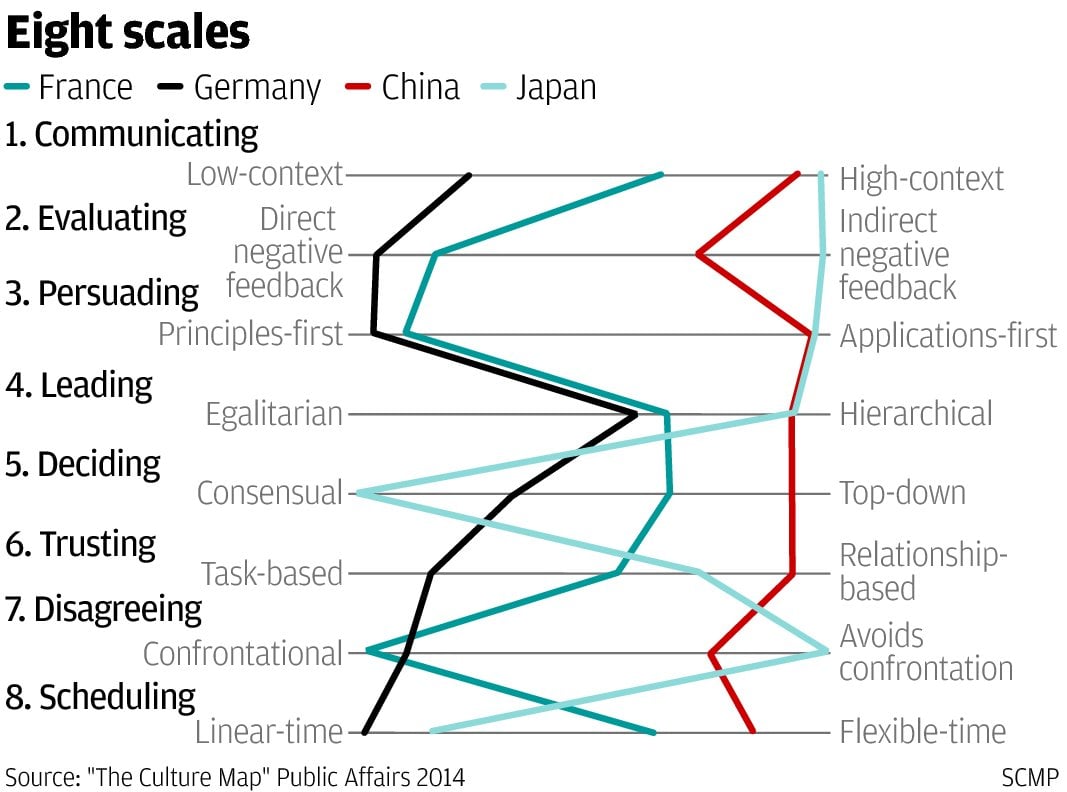
My research question is to explain a Little bit deeper the Eight-scale tool for mapping cultural differences by Erin Meyer, in order to improve our knowledge when negotiating.


The first scale is communicating, in which the high context and the low context plays an important role. In low context the communication is direct, they say the things how they are, and they are precise; while in the high context the message is implicit, so more is left to interpretation. The second scale is evaluating, this measures a preference for frank versus diplomatic negative feedback, it means giving the feedback or criticism in an honestly or direct way, or in a soft or indirect way. The third step is persuading, so you need to understand how they balance holistic and specific thought patterns, which can be based on the philosophical, religious and educational assumptions and attitudes that each culture has,so the principles first and applications first are really important to understand the culture decisions or thoughts. The fourth step is leading; this step is based on the degree of respect that is shown to authority figures, so it is important to understand if the culture is a hierarchical culture or an egalitarian one.

The fifth step is deciding, it is the degree to which a culture is consensus-minded, so you have to understand if the decisions are taken in a democratic way or just by unilateral decisions. The sixth step is trusting, in this step is important to have clear the differentiation between the cognitive trust (task based) and the affective trust (relationship based), in order to identify which kind of trust is being built between you and the culture. The seventh step is disagreeing, this step is important to have a measure between tolerance for open disagreement, looking to avoid the confrontation and the inclination to see this situation as helpful or harmful to the relationships, being confrontational. The last step is scheduling, this step try to analyze the degree between the quantity of value that is placed on operating in a structured, linear  time schedule versus a flexible time schedule.

http://www.scmp.com/business/economy/article/1518529/mapping-global-cultural-differences-offers-advantages-business

miércoles, 5 de noviembre de 2014

INTRODUCTION TO INTERCULTURAL NEGOTIATION

To give an introduction into the intercultural negotiation, first is important to understand what it means, for intercultural we are referring to people from different countries which handle a dialogue or negotiation in order to reach a desire outcome. When negotiating with people from other countries, is important to have in mind and understand that they are not like you, they have different beliefs, traditions, religion, feelings, reactions, thinking’s, behaviors, and so on, and that you have to be willing to cooperate and to be respectful and open minded in order to be successful.  The values and assumptions play an important role when negotiating, because it can lead to misunderstandings or even uncomfortable or offensive situations. Each person has different ways to see the same problem, it depends on the values and assumptions, that the problem will be taken in a negative or positive way; the best example was the case state in class called “Abigail” as we were discussing with the other partners we got into the conclusion that final result depends on the level of values the person has, for example for some people the mother was the worst person in the story, because a mother should always help her children no matter what (this can be seen in a culture where the family ties are very important), but for some it was not that bad, because they assumed the girl had a prudential age to take her own decisions, so it was not the mothers fault.
As my research question, I wonder, even do we know that not all the people behave the same way, even do the culture identify us, the way we talk, the things we like or we don’t like to do, and so on, why do we always get into stereotyping others? I talk for myself when I say that I don’t feel like I behave like a regular Colombian person, I’m shy, I don’t like to party or to drink, I like to be with small groups, or just with my family, boyfriend and close friends, even do I know I don’t feel like the others and there are more people like me, I tend to stereotype people from other countries, why does it happens?
As I read, we tend to stereotype when we are unable to get the whole picture or to obtain all of the information needed to understand and get along with the person we are talking to. Stereotyping in some cases help us to identify the way the person behave in order not to offend or to disturb, but others stereotypes are just like unfair discriminations, for example saying that all the Latin people are unpunctual, when there are lots of them that like to be always on time, other example can be saying that all Germans are rude or talk like there are always mad or angry, when you can find lots of Germans that are very gentle and friendly, and their voice is soft and calm.

jueves, 28 de agosto de 2014

GLOBALIZATION AND CULTURAL HYBRIDIZATION

As the time has change, the independence of the countries lead to the globalization known as the minimization of the economic barriers between the states, and with this the entry of new products, people and with it new cultures, traditions, ideas and entry of new companies and with it international competition and customers. Is important to have in mind that the globalization will not only lead to positive effects but also it may affect the country and the cultures in a negative way. For example, the entry of new strong international companies may affect significantly the national ones and even more the “beginners”, making them lose a lot of money and customers and harming in that way the profitability of the company and therefore the employees (they may be fired). The positive effects of a globalization can also lead to more possibilities of job, and the development of new areas, that helps to the prosperity and benefits the citizens, giving them an extended number of options in means of life styles, technology, food, clothes, medicine, machines, and so on. The entry of new technologies can make the countries more independent and auto-sufficient, emphasizing the individualism, facilitating processes and procedures, searching’s, domestic activities, etc. and that way saving and optimizing their time.  When talking in means of culture, it can be affected or influence in a positive or negative situation, globalization may lead to immigration of citizens, which means also the entry of a new culture that may try to be impose or adapt their traditions and behaviors, creating in that way a new blended culture or even destroying existing ones; In the other hand it can mean the acquisition of new ideas, behaviors or ways of thinking that may help the existing cultures to grow and improve, or to develop new subcultures.

In my research question for this class I will like to go deeper in the explaining of the cultural hybridization. The cultural hybridization can be seen as a process in which the cultures all around the world cling to the characteristics and strong aspects and traditions of their culture, while adapting to a degree of “homogenized global culture”. So it will lead to a mixing of two different behaviors or traditions or even language, known as a hybrid.  For example, due to the non-stop immigration from Mexico to USA, the Mexicans and even the Americans start to adopt the two kinds of culture and also languages, mixing the English and the Spanish based on the situation, and trying to adapt to the new environment without forgetting their native culture. Another big example of the cultural hybridization can be seen in Colombia with the culture best known as “otakus” in other words, Colombians that are in love with the Japanese culture and the Anime (Japanese cartoons), they will adapt some Japanese behaviors in their everyday, also mixing the languages when speaking Spanish, using commonly Japanese words as “kawaii”, “arigatou”, “konnichiwa”, “sayonara” and so on.


viernes, 15 de agosto de 2014

THE DPI AND IT INFLUENCE IN THE UAI.

The most important topics for this class are the distance power (high and low PDI), and the uncertainty avoidance (high and low UAI), because these two factors are determinant in the behavior or customs of a culture. When talking about the power distance there is the existent of two societies the ones identified with the high level and the ones with the low one.  The PDI consider that there is an inequality between countries, however some countries can be more unequal than other, and These differentiations are related to the occupations, education, incomes and in some places the genders. These differentiations are related to the occupations (economy and social classes), education, and incomes and in some countries the genders. When talking about a low PDI country, the freedom has a priority instead of equality (even so they are looking for the minimization of the inequality), which can be explain by the leadership of young people, and their need to be independent. There is not distinction of social and economic classes; one example for this kind of culture is Switzerland, referring specially to the German speakers with a percentage of 34, because they have the believe that inequality among the people should be minimized, highlighting the existent of independence and equal rights, so in a firma all the employees expect to be consulted; and the attitude towards the managers is given in an informal way, calling them for their first name. Finally, due to the decentralization of the power, the control is disliked by the citizens. So it’s normal to say that a teacher will gain the same amount of money than a constructor.  For another part, there is the high PDI, where there is not too much freedom, and the equality is controlled, so the low and high social and economic classes are protected and differentiated. The leaders are older, and the possibility of independence is limited.  One example for this kind of culture is Japan with a percentage of 54, because of their hierarchical position in the society, in means of businesses, all the decisions taken  must be confirmed by each hierarchical layer and finally by the top management in Tokyo, So the employees expect to be told, but without power of decision.  Also the big distinction can be seen when referring to a teacher or professor, the position and reputation of them goes above everyone, being almost in the same level of the emperor.
In means of uncertainty avoidance, it is consider as the uncertainty or ambiguously a society has about the future and how to control it, or avoid in some way the bad situations that may come. This aspect is highly correlated to PDI in some countries and also with age. As a very explicit example of a low UAI, there is Singapore in which their UAI is correlated to their PDI catalogued as 74%, Singaporeans call their society a fine country, because as they say “You’ll get a fine for everything”, so they have to abide to many rules, in order to avoid problems.  Therefore there is no stress or anxiety, because everything is already controlled, and with it their emotions, but giving them a sensation of happiness and peace. In means of a high UAI, there is the example or Greece with a percentage of 100, meaning that they are not comfortable with unknown situations, generating a higher level of stress and anxiety, making them feels in some way unhappy. The high UAI can be explain or related in some way with the Greek myth about the “birth” or creation of the world that says “at the very beginning there was only Chaos but then Cronos the God of the time came, in order to organize the life and make it easier to manage”. Laws and norms are determinant in order to have a clarify structure, and therefore should not be broken. To conclude the correlation between the level of DPI and UAI can give a wide and easiest explanation of the organization and behavior of a country.

About the research question, I will like to go deeper into the finding realized by Hofstede and Michael Harris, known as Confucianism or Confucian dynamism, applied to 23 countries around the world, and which is seemly link with economic growth, and based on the teachings of Confucius, a famous Chinese philosopher. The teachings are in first place that the stability of a society is based on the unequal relationships; in second place that the family is determined as the “prototype” of all social organizations; in the third place that a virtuous behavior toward others consists on the well-known expression “treat others as one would like to be treated oneself”. And the fourth and last one, that by acquiring skills and education, by working hard, by not spending more than necessary, and by being patient and persevering, is the way a person can achieve with virtue the daily tasks of the life.

References:

viernes, 8 de agosto de 2014

HAPTIC AND SILENCE, CRUCIAL ASPECTS TO HAVE IN MIND WHEN INTERACTING WITH OTHERS.

When getting to communicate with others, there are two aspects that will always, or most of the times take place in the negotiation, dialogue or interaction; and assuming it in the wrong way will lead to conflict or uncomfortable situations. Based on this, I decided that “The silence” and “The haptic” are the most important topics of the class.  As we know the haptics can be mostly related to the behavior of the person that comes from the culture in which he or she grew up; the necessity to touch someone increase or decrease depending on the culture or the confidence between the people, but there is a common error that appear in the barriers to communication and it is assuming similarities, you cannot treat people from a different or a same culture, the way you treat your relatives or friends.  The haptics can mean many things as we said in class, affection, confident, need for attention, attachment, but also sexual content; I will like to highlight an example based on the Tv show “Outsourced: Touch of an Anglo” that talk about an internationalized firma located in India with a American boss (Todd)that do not know anything about this culture, for him touching the others was a pretty normal and friendly action, but he didn’t realize that in India, touching the shoulder has a sexual content and can be very offensive, his bigger problem was assuming the similarity with the American culture, and due to this situation he was almost fired.  


As the professor Peter Andersen says "A person who touches a lot says, 'I'm a friendly, intimate person.' More touch-oriented doctors, teachers, and managers get higher ratings."
I do agree that touching can help improve a relation, and also give a nicer or warmer perception or image of the person, but, is important always to have in mind the concept of proxemics, that is known as the personal space, and that is also related to the culture.
In the other hand the silence can play a big role when interacting with others, as this action can have lots of meanings.  “Silence grants the point or Silence implies or gives consent”, when someone prefer or decide not to say something, the other can get into many conclusions, maybe this person agree or disagree about my idea, or maybe is confuse, or  embarrass, or it’s just a way to show me respect; that may  end with a feeling of insecurity in the “Receptor”. But how a person can deal or handle the silence? This is a complex question, due to all the implicit possibilities that it implies; the best way will be to stop assuming things, or trying to wonder or figure out what the other wanted to say by the “silence”, and this is due to the tendency of assuming negative messages, which can lead to misunderstandings, because “Discomfort lies in uncertainty”. If you don’t know what the other mean by keeping the silence, just ask what they want to transmit by doing it. 
For my research question I found really interesting the development model of intercultural sensitivity that is related to ethnocentrism, the other reason is that I was a little confuse about this topic because of the quality of the slide and the short time it was due. So I will like to go deeper in the study of this model, that is used in an international way to help training intercultural relations and that way, facilitate the assess to an intercultural competence; to start it was created by Dr. Milton Bennett (1986 - 1993), which is the founder of the ICI, known as the Intercultural Communication Institute, and also of the IDRI, also known as the Intercultural Development Research Institute, that help to the deep and extended research of the intercultural development, and therefore facilitate the  intercultural adaptation.

He created this model with the purpose to explain the way the people react or respond to the differences that each culture possesses. When the relation or interaction increases, then this “relationship” will make this difference of culture complex. The three first stages will be related to the ethnocentrism, leading to the stages of “Denial, the avoidance of other cultures, because they are seen as different or abnormal”, “Defense, the tendency to critic in a highly way the people from other cultures, creating a status where there is a superior culture and therefore an inferior one.” and “Minimization, the trivialization of the culture, which look for the correction or adjustment of  the others behaviors to look for similarities and that way to reach their ideals”. The second three stages will be related to the ethnorelative, and with this stages comes the “Acceptance, the necessity of understanding the differences in a culture, due to the increase of interaction with others”, the “Adaptation, the interaction with a different culture, will help improve or even change in some way the perception and/ or behavior of the existing one to adapt easily “ and finally the “Integration,  the total inclusion into the new culture, caused by a feeling of union and equality”.